> For the complete documentation index, see [llms.txt](https://docs.phoenixlidar.com/llms.txt). Markdown versions of documentation pages are available by appending `.md` to page URLs; this page is available as [Markdown](https://docs.phoenixlidar.com/spatialexplorer-8-and-9/user-interface/toolbars/rover/rover-settings-and-profiles/navigation-system.md).
# Navigation System
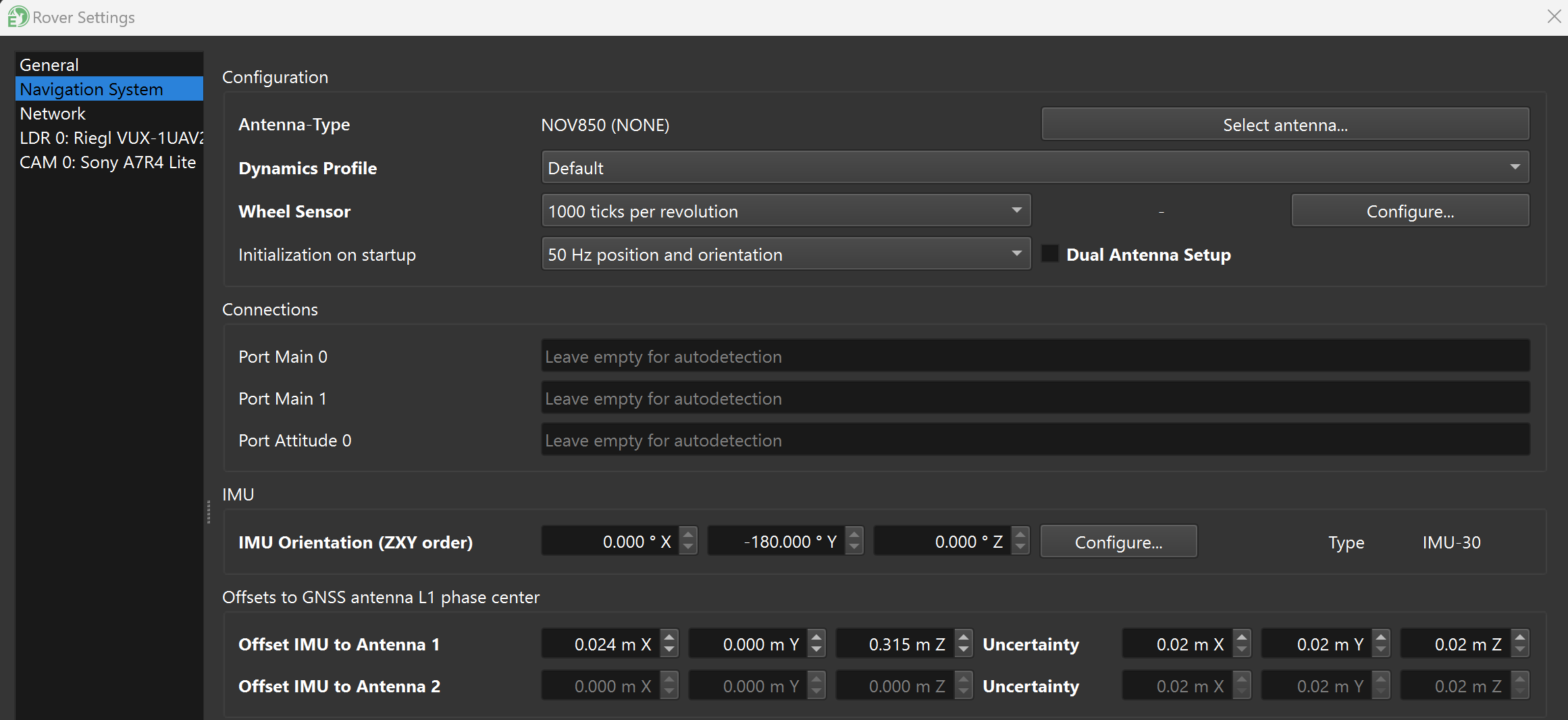
The navigation system menu contains settings such as IMU orientation, GNSS antenna type, and GNSS antenna lever arm offsets:
### IMU Orientation
IMU orientation indicates how the IMU axes need to be rotated so that they align with the vehicle axes. Per the Novatel InertialExplorer convention, vehicle axes are: X-vehicle right, Y-vehicle forward, Z-vehicle up. This InertialExplorer definition of vehicle axes is the most relevant as InertialExplorer / NavLab use this definition of the vehicle for trajectory processing. If your IMU orientation is incorrect, it's very likely that trajectory processing will not succeed.
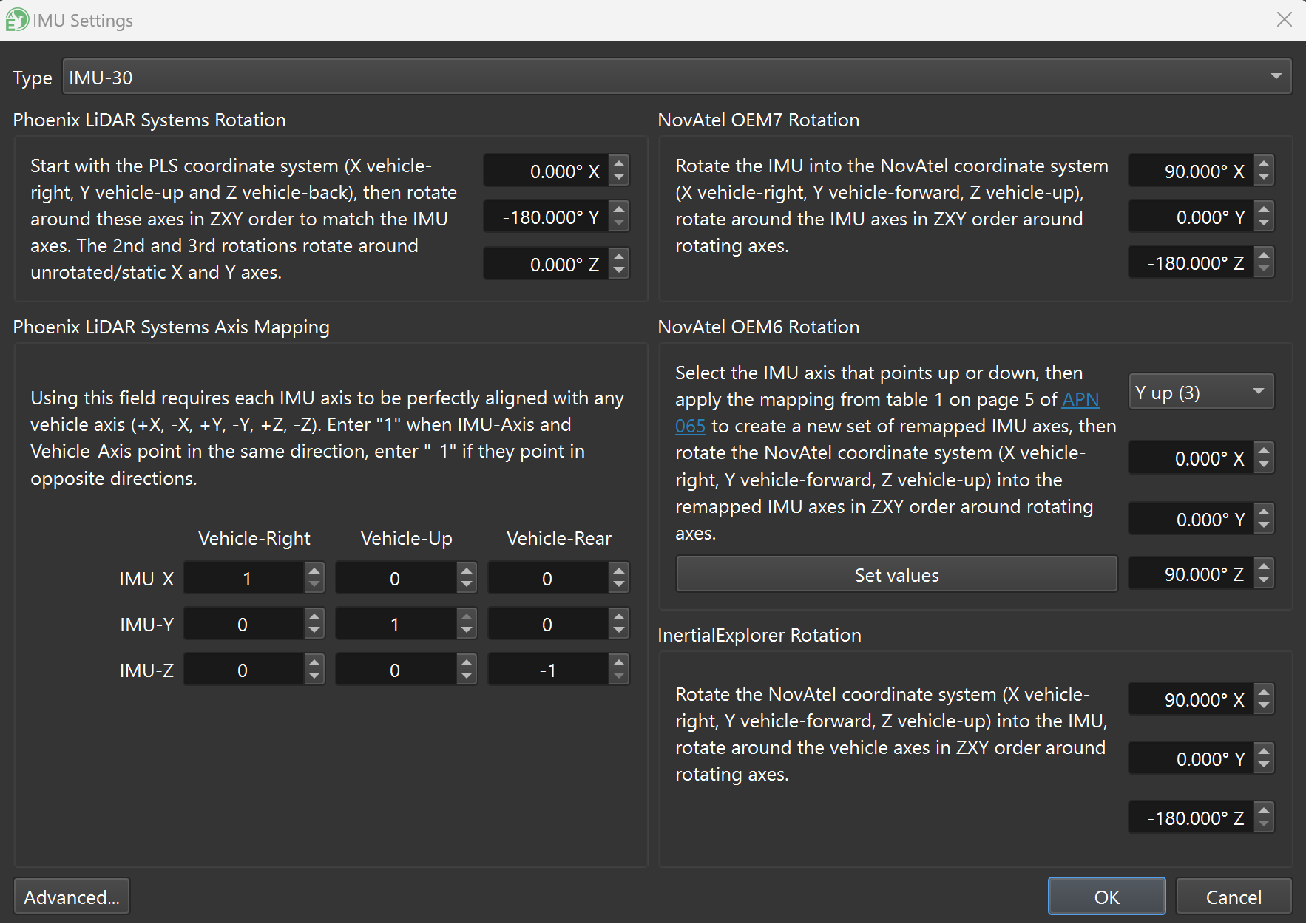
To change the IMU Orientation, click **Configure.** The IMU orientation is displayed in many different conventions:
It's recommended to change the IMU orientation using the **Axis Mapping** matrix, to prevent from incorrectly determining X,Y,Z rotations. More information can be found about IMU orientation [here](/hardware-and-interfaces/gnss/orientation-and-offsets/imu.md).
{% hint style="info" %}
IMU orientation depends not only on the model of the IMU, but also the way the lidar system is installed in respect to the vehicle.
{% endhint %}
### GNSS Antennas
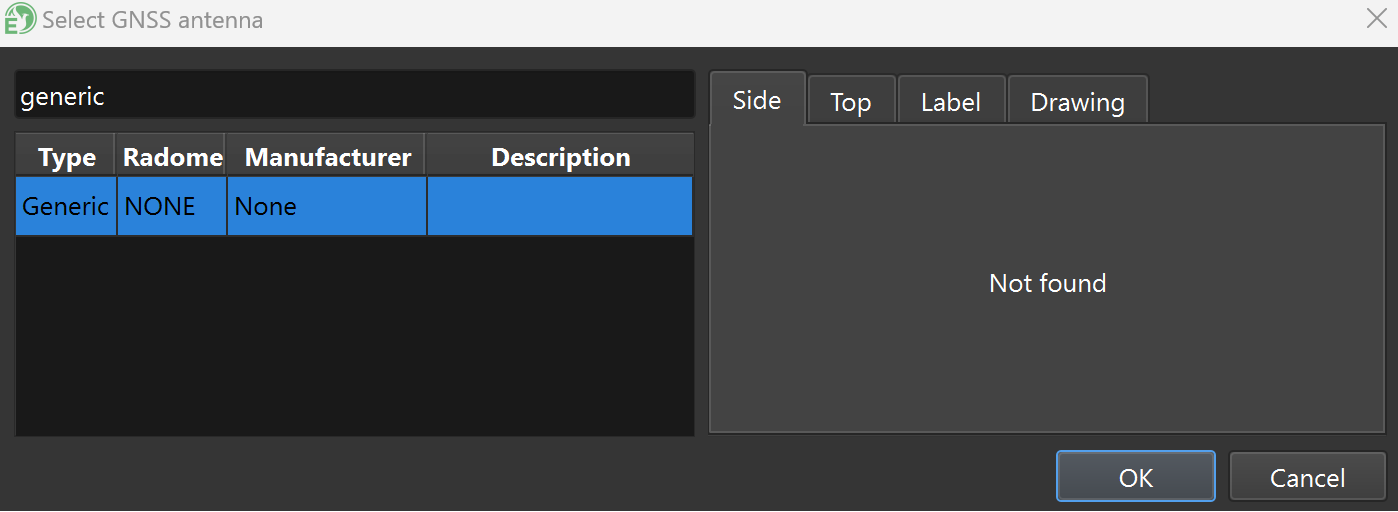
**Antenna type**: Indicates the antenna model. If the antenna is not NGS Calibrated, it will not appear in the list - in this case, use the **Generic** antenna model:
**Antenna lever arm offsets**:
The distance between the IMU and GNSS antenna phase center must be known precisely. The X, Y, Z translations from IMU to antenna, otherwise known as GNSS antenna lever arm measurements, are entered here, along IMU axes:
If your system utilizes dual antenna functionality, both antennas will require offsets to be entered. More information about GNSS antenna lever arms can be found[ here](/hardware-and-interfaces/gnss/orientation-and-offsets/gnss-antennas.md).
{% hint style="info" %}
Offsets from IMU to antenna are measured along IMU axes. For example, if the IMU's Z axis points down, and the GNSS antenna phase center is 35 cm above the IMU, this would be entered as -0.350 m Z, because a positive Z value in this case is defined as downwards (or vehicle down).
{% endhint %}