> For the complete documentation index, see [llms.txt](https://docs.phoenixlidar.com/llms.txt). Markdown versions of documentation pages are available by appending `.md` to page URLs; this page is available as [Markdown](https://docs.phoenixlidar.com/spatialexplorer-8-and-9/user-interface/toolbars/workflow/lidarsnap-v4/ground-control-with-lidarsnap/full-adjustment.md).
# Full Adjustment
It's particularly common with mobile lidar data sets to use control to georeference the scan. This is because the input trajectory is not accurate enough on it's own, and the user must leverage GCPs which are identifiable in the pointcloud.
As discussed in the previous section, vertical adjustment to ground control can be performed automatically; however, if horizontal adjustment of the pointcloud is required to match GCP targets, the user must [create a Full Correction](/spatialexplorer-8-and-9/user-interface/windows/corrections.md). It may be necessary to create several corrections, depending on the data set. These corrections inform LiDARSnap on the direction and magnitude required to shift the scan at any given point along the trajectory
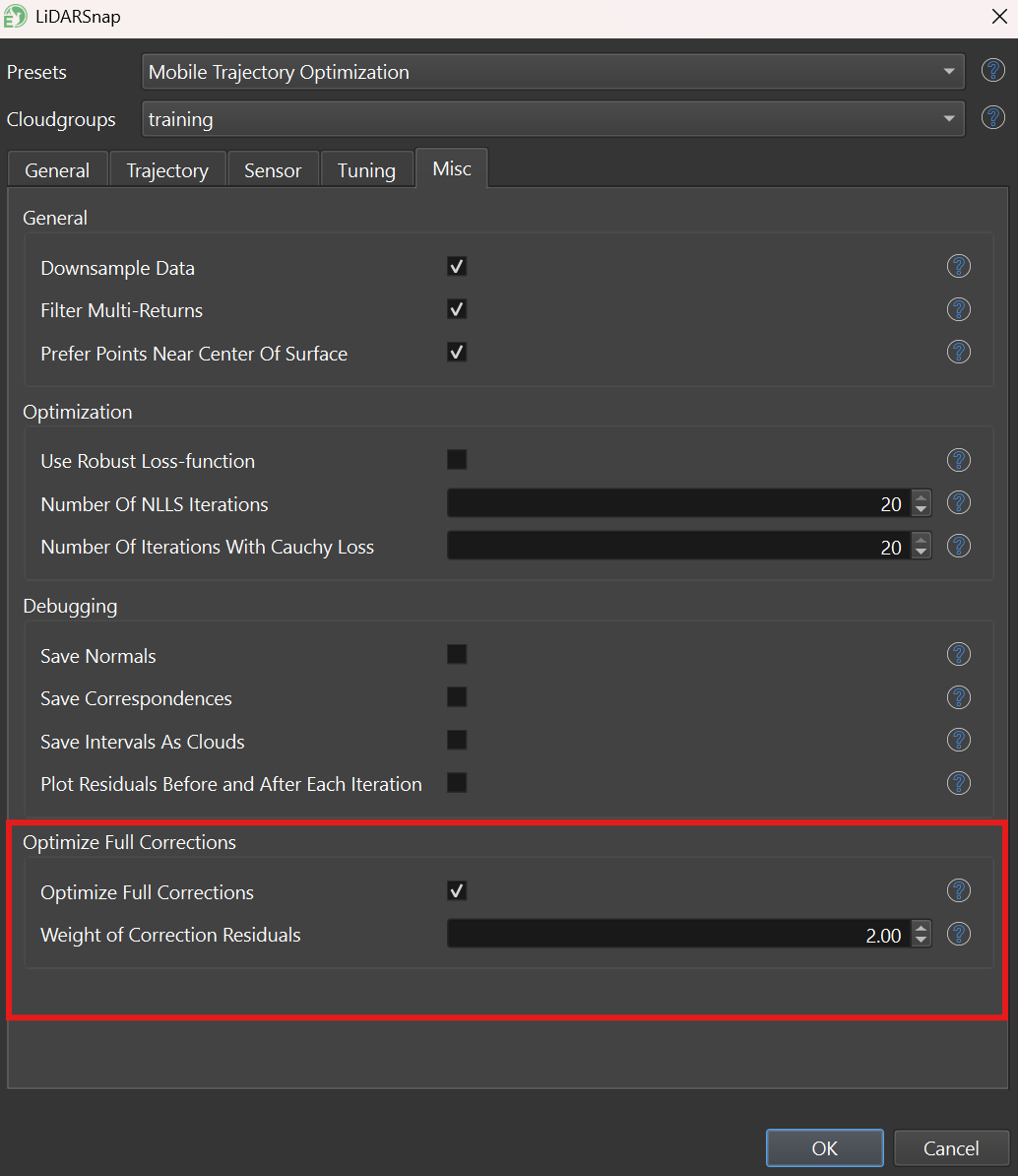
Full corrections (i.e. 3D corrections, with a horizontal and vertical component) can be enabled in the LiDARSnap **Misc** tab:
The **Weight of Correction Residuals** depends on the data set. Cloud-to-cloud observations also influence LiDARSnap during optimization, so it may be necessary to increase the **Weight of Correction Residuals** when many cloud-to-cloud observations are present (dense urban areas). Start with a lower weight (e.g. 2 - 10), and increase the weight (e.g. 20-100), if necessary.
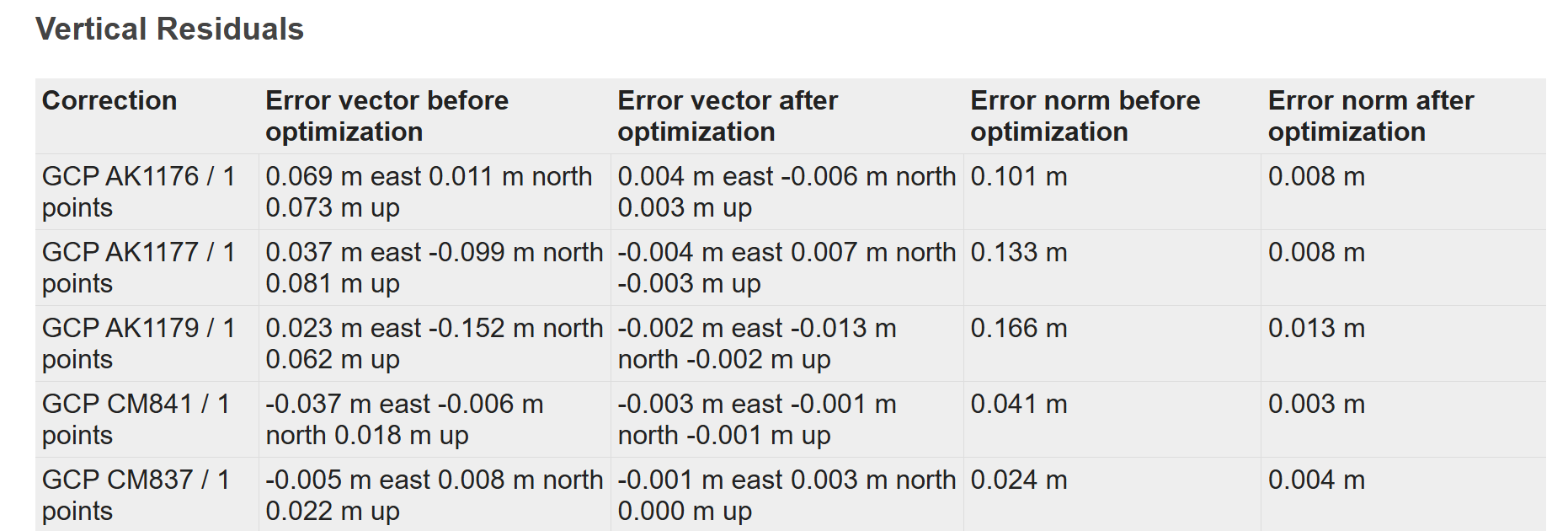
3D correction residuals, pre and post-optimization, are displayed in the LiDARSnap trajectory report: